

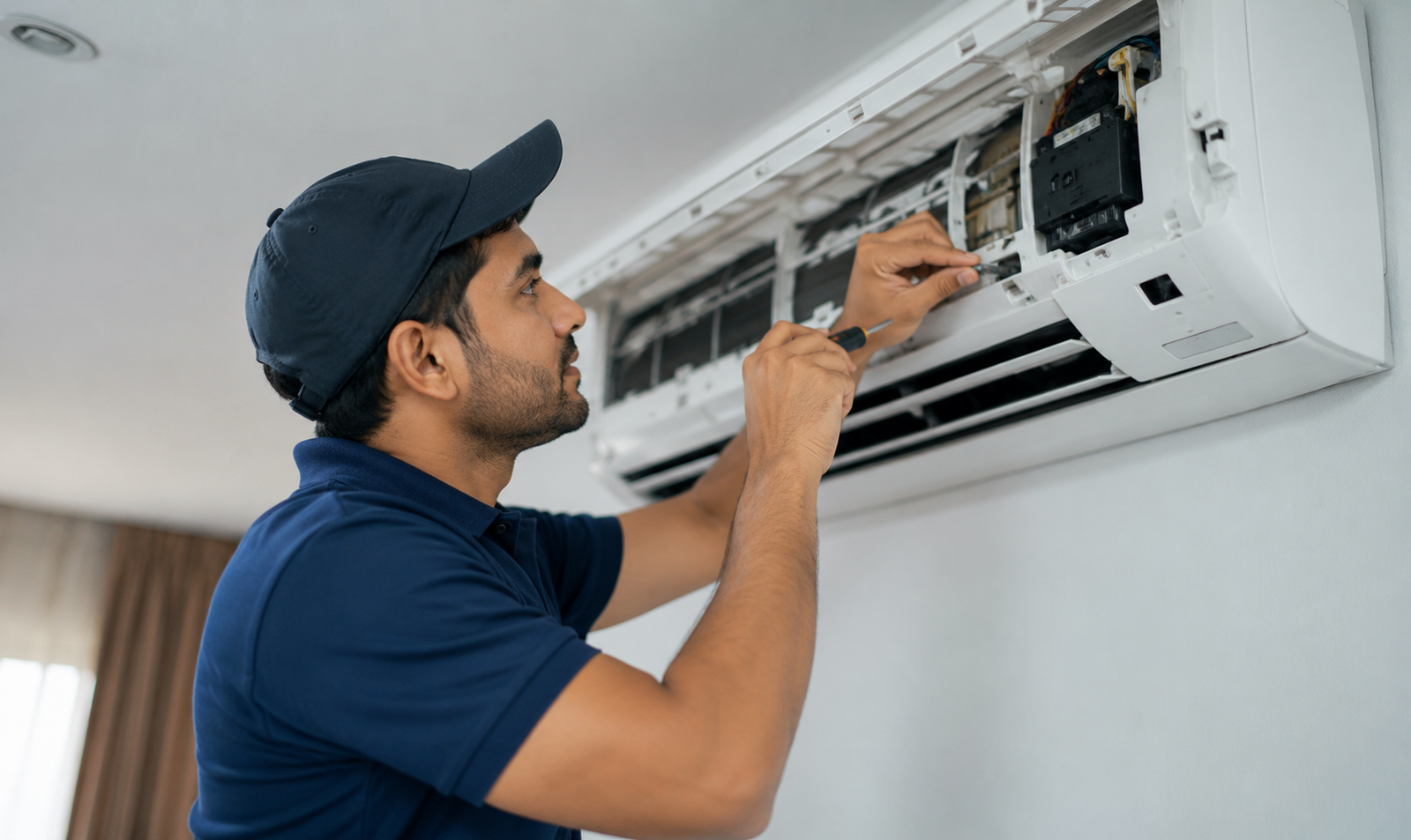
If you are searching for air conditioner repair near me, the best approach is to compare several qualified local HVAC companies rather than choosing the first result you see. Check licensing and insurance requirements in your state, recent customer reviews, service availability, written estimates, warranties, and whether the technician is qualified to handle refrigerants.
For refrigerant-related work, U.S. EPA rules require technicians performing covered service or repairs to hold Section 608 certification.
How to Find Air Conditioner Repair Near Me
Start with Google Search or Google Maps and search for:
- Air conditioner repair near me
- AC repair near me
- HVAC repair near me
- Emergency AC repair near me
- Central air repair near me
- 24-hour AC repair near me
Google says local results are primarily influenced by relevance, distance, and prominence. This means the company physically closest to your home will not necessarily be the first result.
Once you have several options, compare at least three companies before hiring one when the situation is not an emergency.
Check the Company’s Service Area
Make sure the HVAC company actually serves your ZIP code or city.
Some businesses appear in nearby search results while their technicians are based farther away. Ask whether there is an additional travel fee before scheduling a visit.
Look Beyond the Star Rating
A high rating can be useful, but do not rely on it alone.
Look through recent reviews for comments about:
- Arriving on time
- Diagnosing problems correctly
- Explaining repair options
- Honoring quoted prices
- Warranty support
- Emergency response
- Cleanliness and professionalism
A company with detailed recent reviews may give you more useful information than one with only a handful of perfect ratings.
When Should You Call an AC Repair Technician?
Not every cooling problem requires a major repair, but certain symptoms deserve professional attention.
Call an HVAC technician if you notice:
| AC problem | Possible reason |
|---|---|
| AC is running but not cooling | Refrigerant, compressor, coil, airflow or electrical problem |
| Warm air from vents | Thermostat, compressor or refrigerant issue |
| Weak airflow | Dirty filter, blower problem or duct issue |
| AC repeatedly turns on and off | Electrical, thermostat, airflow or system-sizing issue |
| Water around indoor unit | Condensate drain or coil problem |
| Unusual buzzing or grinding | Electrical or mechanical component problem |
| Sudden increase in electricity use | Reduced system efficiency or equipment problem |
| Some rooms stay hot | Airflow, ductwork or system-balancing issue |
These symptoms can have several causes, so diagnosing the system before replacing parts is important.
Check These Simple Things First
Before paying for a service visit, homeowners can safely check a few basic items:
- Make sure the thermostat is set to Cool.
- Check that the temperature setting is below the current room temperature.
- Inspect the air filter and replace it if it is heavily clogged.
- Make sure supply vents are not blocked by furniture or other objects.
- Check whether the outdoor unit is obstructed by obvious debris.
- Confirm whether the appropriate circuit breaker has tripped.
If the breaker trips repeatedly, do not continue resetting it. An electrical problem should be inspected by a qualified professional.
Avoid opening refrigerant lines, attempting compressor repairs, or working on internal electrical components unless you are properly trained.
How to Choose a Reliable Local AC Repair Company
Price matters, but it should not be the only deciding factor.
ENERGY STAR recommends learning about state licensing and insurance requirements, getting referrals and references, expecting a proper evaluation, and comparing written itemized estimates.
1. Verify Licensing and Insurance
HVAC contractor licensing rules vary by state and sometimes by city or county.
Ask for:
- Company license information where required
- Proof of liability insurance
- Workers’ compensation coverage when applicable
You can then verify licensing through the relevant state or local government agency.
2. Ask About EPA Section 608 Certification
If the repair involves opening a refrigerant circuit, adding refrigerant, removing refrigerant, or performing other covered refrigerant work, EPA Section 608 certification requirements apply.
Do not assume every general handyman is qualified to perform this type of AC work.
3. Request a Written Diagnosis
Before approving an expensive repair, ask:
- What exactly failed?
- What caused the failure?
- Can the component be repaired?
- Does it need replacement?
- Are there other damaged components?
- What warranty covers the repair?
A professional technician should be able to explain the problem in understandable terms.
4. Compare Written Estimates
For non-emergency repairs, comparing multiple estimates can help you identify unusually high or suspiciously low quotes.
The Federal Trade Commission recommends getting multiple written estimates and reviewing the details rather than automatically choosing the lowest bidder.
A useful estimate should identify the work, parts, labor and total expected cost.
How Much Does Air Conditioner Repair Cost in the USA?
There is no single price for AC repair because costs depend heavily on the failed component, system type, location, labor rates and whether emergency service is needed.
As of August 2026, Angi reports professional HVAC repairs commonly ranging from about $130 to $2,000, with larger or more complicated repairs potentially costing more. Its reported initial HVAC service-call range is around $100 to $250.
Examples from Angi’s 2026 national estimates include:
| Service or repair | Approximate 2026 range |
|---|---|
| Initial HVAC service call | $100–$250 |
| AC tune-up | $70–$200 |
| Capacitor replacement | $100–$250 |
| Fan motor | $100–$700 |
| Refrigerant recharge | $100–$500 |
| Refrigerant leak repair | $250–$1,500 |
| Compressor repair/replacement work | $800–$3,000 |
These figures are broad national estimates rather than guaranteed prices. Your actual quote can vary substantially by city, equipment, brand, system accessibility and current parts availability.
Ask whether your diagnostic charge will be credited toward the repair if you approve the work.
Emergency AC Repair Near Me: When Is It Worth Calling?
Emergency or after-hours AC service usually costs more than a regular appointment.
An urgent service call may make sense when:
- Extreme heat creates a health or safety concern.
- The system smells like it is burning.
- You notice smoke or an obvious electrical problem.
- The AC is leaking enough water to threaten your home.
- A vulnerable household member cannot safely tolerate the indoor temperature.
For a burning smell, smoke or serious electrical concern, turn the system off when it is safe to do so and seek qualified assistance.
If the issue is simply reduced cooling and indoor conditions remain safe, scheduling a regular appointment may save money.
Warning Signs of an AC Repair Scam
Be cautious if someone:
- Appears unexpectedly and claims your AC urgently needs work.
- Pressures you to make an immediate decision.
- Demands the entire payment before starting.
- Will not provide a written estimate.
- Refuses to provide licensing or insurance information.
- Insists on cash or wire transfer only.
- Recommends an expensive replacement without properly inspecting your system.
The FTC specifically warns consumers about contractors who pressure homeowners, demand full payment upfront or insist on questionable payment arrangements.
Repair or Replace Your Air Conditioner?
An expensive repair does not automatically mean you need a new AC system.
Consider replacement when:
- Major repairs are becoming frequent.
- Important parts are difficult to obtain.
- The system performs poorly even after maintenance.
- Energy costs have increased substantially because of declining efficiency.
- A major repair approaches a significant percentage of replacement cost.
Before deciding, request both a repair estimate and a replacement estimate.
If replacement is recommended, ENERGY STAR advises that the contractor inspect the home and existing system rather than simply assuming that a larger unit is better. Proper equipment sizing and duct evaluation matter.
Questions to Ask Before Hiring an AC Repair Company
Before scheduling service, ask:
- Do you service my ZIP code?
- What is your diagnostic or service-call fee?
- Is emergency service priced differently?
- Are your technicians qualified for refrigerant work?
- Are you licensed and insured where required?
- Will I receive a written estimate before repairs begin?
- What warranty covers parts and labor?
- Will you explain whether repair or replacement makes more sense?
Getting clear answers before the technician starts work can reduce unexpected charges.
FAQs
Q1. How do I find the best air conditioner repair near me?
Search local HVAC companies through Google Search or Maps, then compare recent reviews, licensing and insurance, service areas, written estimates, warranties and technician qualifications.
Q2. How much does an AC service call cost?
Angi’s August 2026 national cost guide lists initial HVAC service calls at roughly $100–$250, although actual prices vary by location, company and service time.
Q3. Should I call an AC technician if my air conditioner is blowing warm air?
Yes, if checking the thermostat, filter and basic airflow does not solve the problem. Warm air may result from several mechanical, electrical or refrigerant-related problems.
Q4. Does an AC technician need EPA certification?
Technicians performing work that can open or disturb covered refrigerant circuits generally need EPA Section 608 certification.
Q5. Should I choose the cheapest AC repair company?
Not automatically. Compare the diagnosis, parts, warranty, credentials and scope of work. The FTC recommends getting multiple estimates and not automatically selecting the lowest bidder.
Conclusion
Searching air conditioner repair near me can quickly produce dozens of choices, but the nearest company is not automatically the best one. Compare qualified local HVAC contractors, verify appropriate credentials, read recent reviews, request a written diagnosis and understand the price before approving major work.
If your AC is currently failing, start by checking your thermostat, filter and basic airflow. If the problem continues—or involves refrigerant, electrical components, leaks or major mechanical parts—contact a qualified local HVAC professional.
