

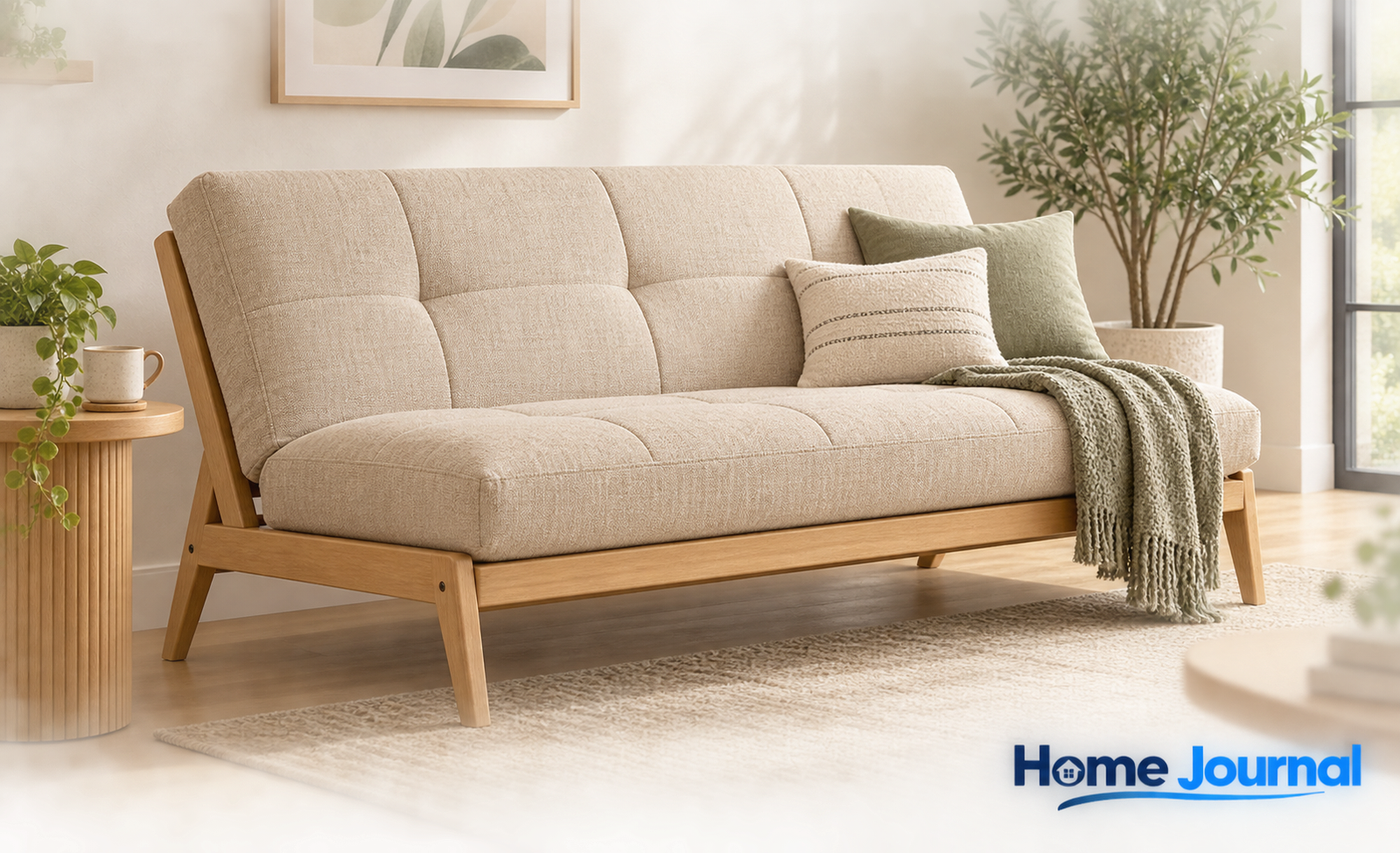
A futon couch is a convertible seat that opens into a sleeping surface, making it useful for living rooms, guest rooms, and spaces that serve more than one purpose. The best choice fits your room when fully open, feels comfortable for its main job, and has a mechanism you can operate easily. Appearance matters, but the mattress, frame, and usable sleeping area deserve equal attention.
Buying one becomes easier when you separate everyday needs from occasional extras. Will you sit on it each evening, host weekend visitors, or use it as your main bed? This guide explains what to measure, how to compare construction, and which details are easy to overlook, helping you choose furniture that works beyond the showroom photograph.
1. Understand Which Futon Couch Design Suits Your Needs
Retailers use “futon” to describe several types of convertible furniture. A traditional Japanese futon is floor bedding that can be folded away. A Western futon typically combines a folding frame with a separate mattress. Upholstered convertible couches are also frequently sold as futons, although their cushioning may be permanently attached.
That distinction affects maintenance and replacement options. With a separate mattress, you may be able to replace the sleeping surface while keeping the frame. With fixed upholstery, replacing worn padding can require professional work. Always check what the listing includes: some advertised prices cover only the frame.
| Design | How it converts | Main buying consideration |
|---|---|---|
| Folding frame with separate mattress | Frame opens and mattress unfolds | Mattress must suit the frame’s folding pattern |
| Click-clack couch | Backrest lowers into a flat position | Check rear clearance and the central seam |
| Split-back convertible | Back sections adjust independently | Confirm the whole surface feels level |
| Pull-out sleeper sofa | A separate bed extends from inside | Check extended depth and mechanism access |
Start with the furniture’s most frequent use. For evening seating and occasional visitors, seat comfort and simple conversion may lead your decision. For regular sleeping, give greater attention to the mattress and sleeping dimensions. A piece that serves two functions still needs to perform its main function well.
2. Measure the Room, Sleeping Surface, and Delivery Route
A couch can fit neatly against a wall and still become awkward when opened. Record its closed width and depth, fully extended dimensions, and any clearance needed behind it. IKEA’s buying guidance specifically recommends measuring for both configurations and notes that click-clack mechanisms require space behind the sofa.
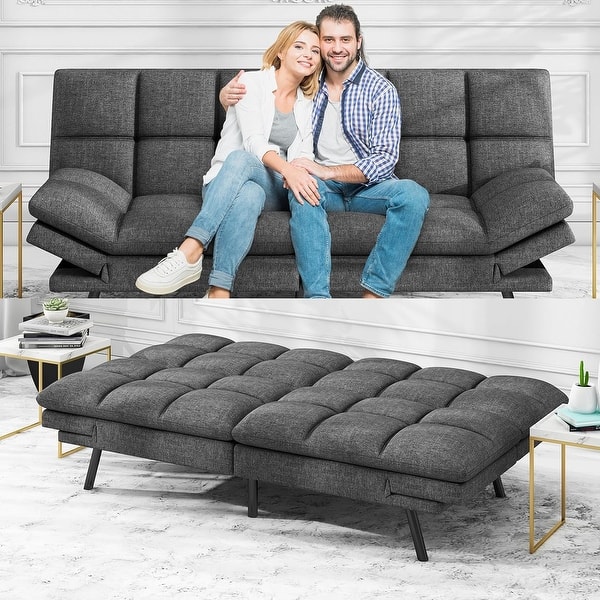
Use painter’s tape to mark the open footprint on your floor. Then check whether you can reach nearby doors, drawers, and storage. Include the coffee table in your plan: moving it occasionally may be manageable, but finding a new place for it every night can become frustrating.
Before ordering, measure these details:
- Overall width: Includes arms and other projecting parts.
- Usable sleeping length: Excludes arms unless they form part of the bed.
- Open depth: Shows how far the converted bed extends.
- Seat height and depth: Helps you compare it with seating you already find comfortable.
- Delivery access: Includes doorways, stairs, corners, and elevator openings.
For example, a couch advertised as 78 inches wide might have only 70 inches between its arms. That overall measurement does not guarantee a 78-inch sleeping surface. This is an illustrative example, so use the actual product specifications when comparing models.
Check mattress measurements rather than relying on labels such as “double” or “full.” Convertible furniture can use nonstandard dimensions, and familiar size names vary between countries. This also affects whether your existing fitted sheets will work.
3. Compare Comfort, Mattress Materials, and Frame Quality
Comfort depends on the complete construction, including cushioning, support, seat angle, and the frame underneath. A thick mattress is not automatically comfortable, and a soft seat does not guarantee a good sleeping surface. For a folding model, the mattress must also bend as intended without interfering with the mechanism.
Look beyond the mattress label
Different fillings create different sensations, but quality varies within every material category.
| Mattress material | What to assess |
|---|---|
| Foam | Whether you sink through to the support beneath |
| Cotton-rich filling | Firmness, weight, and manufacturer care requirements |
| Latex-containing layers | Resilience, overall weight, and folding compatibility |
| Innerspring or hybrid construction | Whether it is specifically designed for the folding frame |
Ask for the mattress construction details when they are available. Terms such as “premium” and “luxury” explain little by themselves. More useful information includes the filling layers, whether the cover is removable, and whether the manufacturer recommends the model for occasional or regular sleeping.
Test both positions
In a showroom, sit as you normally would at home, then try the opened bed. Check the middle, edges, and any junction between cushions. Notice whether your hips sink sharply, a ridge presses into you, or the frame can be felt beneath the padding.
A few minutes can reveal obvious problems, although a brief test cannot establish overnight comfort. If shopping online, examine return terms carefully, including whether opened or assembled furniture can be returned and who pays collection costs.
Inspect the frame and mechanism
Look for secure joints, appropriate center support, and a mechanism that locks firmly in place. Operate it yourself if possible. A convertible bed should feel manageable for the person who will actually open it.
Check the stated weight limit and whether it applies to sitting, sleeping, or both. Avoid assuming that a wooden frame is always stronger than a metal one; design, materials, and assembly all matter.
4. Choose Practical Style and Calculate the Full Cost

The right upholstery should suit both your room and your routine. A pale fabric may work well in a quiet guest room, while a frequently used family space may benefit from a cover that is straightforward to clean. Request fabric samples where possible because screen images can misrepresent color and texture.
Look at the care label before choosing a finish. A removable cover is not necessarily machine washable. Check whether it needs professional cleaning, whether replacement covers are available, and whether the manufacturer provides clear instructions for spills.
For visual balance, compare the couch’s proportions with your other furniture. Narrow arms can preserve seating space within a smaller footprint. Exposed legs may create a lighter appearance, while a deeper upholstered base can look more substantial. Neither approach changes the actual floor space required.
Calculate the complete purchase cost, including:
- Frame and mattress, if sold separately.
- Delivery and assembly.
- A compatible protector and bedding.
- Any optional topper.
- Return collection or restocking charges.
Consider repairability as part of value. Replaceable covers, available hardware, and a separately replaceable mattress give you more options when individual parts wear out. Ask what the warranty covers rather than judging it only by its length.
Care should follow the specific product instructions. Some mattresses benefit from rotation or flipping, while others have a designated sleeping side. The Futon Shop’s care guidance also emphasizes airing its mattresses; follow the instructions for your own filling and cover.
FAQ’s
Q1. Can you sleep on a futon couch every night?
Yes, if it is designed for regular sleeping and provides comfortable support.
Q2. What is the difference between a futon and a sleeper sofa?
A futon unfolds its seating surface, while a pull-out sleeper sofa has a separate mattress.
Q3. Can you put a regular mattress on a futon frame?
Only if it fits and is approved for the frame’s folding mechanism.
Q4. Will a mattress topper improve futon comfort?
A topper can soften the surface but cannot fix sagging or a damaged frame.
Q5. Is an armless futon better for small rooms?
It can save width, but always check its fully opened dimensions.
Conclusion
A good futon couch combines comfortable support, suitable dimensions, and a conversion mechanism that fits your routine. Start with its main purpose, measure both positions, and compare construction before choosing the fabric or color. Check the full purchase cost and return terms so there are fewer surprises after delivery.
